
Coated steel belts on machine-room-less elevators
October 29, 2026
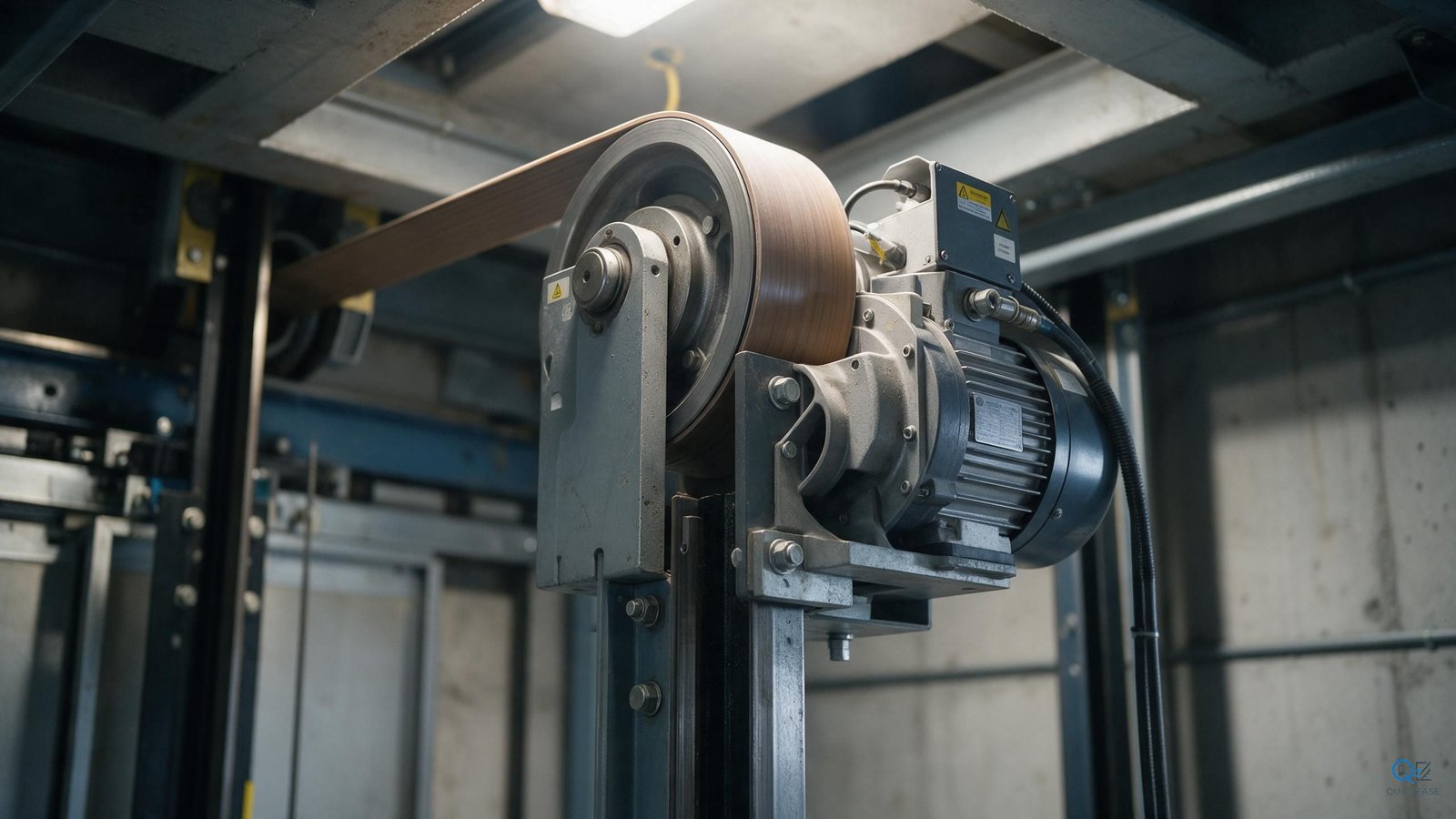
Machine-room-less elevators replaced wire ropes with flat belts in most of the world, and the maintenance trade is still catching up. A rope tells you it is dying: broken wires, a lengthening lay, a smaller diameter. A coated belt tells you much less, and by the time it tells you, it is usually urgent.
The belt is a flat strip of polyurethane with steel cords moulded inside, running on toothed or flat pulleys. The machine sits in the shaft, usually at the top, and the roping is two-to-one: the belt goes from the machine down around a pulley on the car, back up over a sheave, down around the counterweight pulley, and back to the machine. The belt is endless, with no splice to inspect and no termination to check.
The cords carry the load and the polyurethane carries the friction. That division explains the failure modes. The coating wears where it bends around the smallest pulleys, it cracks where it is flexed hardest, and it delaminates where water or oil gets under the edge. The cords corrode when water reaches them through a crack, and a corroded cord loses strength without changing the belt's appearance.
Inspection, then, is a visual and tactile routine rather than a counting exercise. Run the car to the top and look at the belt where it passes over the machine sheave: that is the highest-stress point. Cracks that run across the belt, not just along the edge, are the ones that matter. Then check the edges for exposed cord. A single exposed strand at the edge is a warning; several strands along a metre is a replacement.
Look at the pulleys too. A worn pulley groove with a sharp edge cuts the belt from the side, and debris packed into a groove changes the belt path. Clean the pulleys with a soft brush, never a wire brush or a solvent that attacks polyurethane.
Oil is the enemy. The belt depends on friction between the coating and the pulley, and oil, grease, or a leaking hydraulic unit in the same shaft reduces that friction. The symptoms are subtle at first: the car slips slightly on start with a heavy load, or the leveling drifts by a few millimeters, or the machine makes a chirp at the moment of takeoff. By the time the car slips visibly, the belt may already be glazed, and a glazed belt does not recover.
Tension and tracking are the other two things you can check without instruments. The belt should run centred on each pulley, not rubbing a flange. A belt that has moved to one side is being pulled sideways by a misaligned pulley or a worn guide, and the edge will fail first. Tension is set by the machine or by a tensioning device, and it is not adjustable by feel; if the system uses a tension weight or spring, check it is in its working range.
Elongation matters differently than with ropes. A belt that has stretched beyond the tensioner's range has either been overloaded or has started to lose cord-to-coating bond, and neither is repairable. Some systems monitor belt slip electrically; if the monitoring has been disabled to stop nuisance alarms, nobody will know the belt is slipping until a passenger does.
There is also an age question that no measurement answers. Most MRL belt manufacturers publish an inspection interval and an expected life, and a belt that passes a visual check at eight years is still being judged against a date the factory had in mind. Photograph the belt at every annual visit, keep the photos with the date, and compare: cracks that were two millimetres long last year and are ten this year are the trend you are looking for.
Replacement is a pair job on most MRL layouts. Belts are matched by width, tooth profile, and length, and the two sides of a two-to-one arrangement must be replaced together, because a new belt and an old belt will not share load. Replace the pulleys if the grooves are worn or the bearings are noisy, and clean the whole belt path before the new belts go on. A new belt running through a dirty path picks up the same debris that ruined the old one.
The work happens on the car top and in the shaft, with the machine isolated, and the car blocked against a fall. That is a different risk profile from a machine room, and it deserves a method statement rather than a habit.
The machine sheave and the pulleys deserve the same attention as the belt, because they are what the belt is asked to grip. Run a straightedge across the sheave face and look for a groove worn into the coating surface, and check the pulley bearings by hand with the belt slack: a bearing that rumbles will heat the belt and change its path. A worn sheave with a new belt is the most expensive way to do this job twice.
If the system exposes a slip test, use it. With rated load, let the car start and watch the belt at the machine. A healthy belt moves smoothly with no visible lag between the sheave and the belt surface. A belt that hesitates for a fraction of a second is slipping, and slip is the process that glazes the coating. Where the controller logs slip events, read the log before you look at the belt; the log often shows the problem weeks before it is visible.
For ordering, the four numbers are belt width, belt thickness, cord construction, and centre distance. If the belt is not endless from the factory, ask how the join is made and whether it is field-vulcanised. A belt joined with a mechanical clamp on an MRL machine is a temporary fix, not a repair.