
Testing the governor and safety gear linkage
October 29, 2026
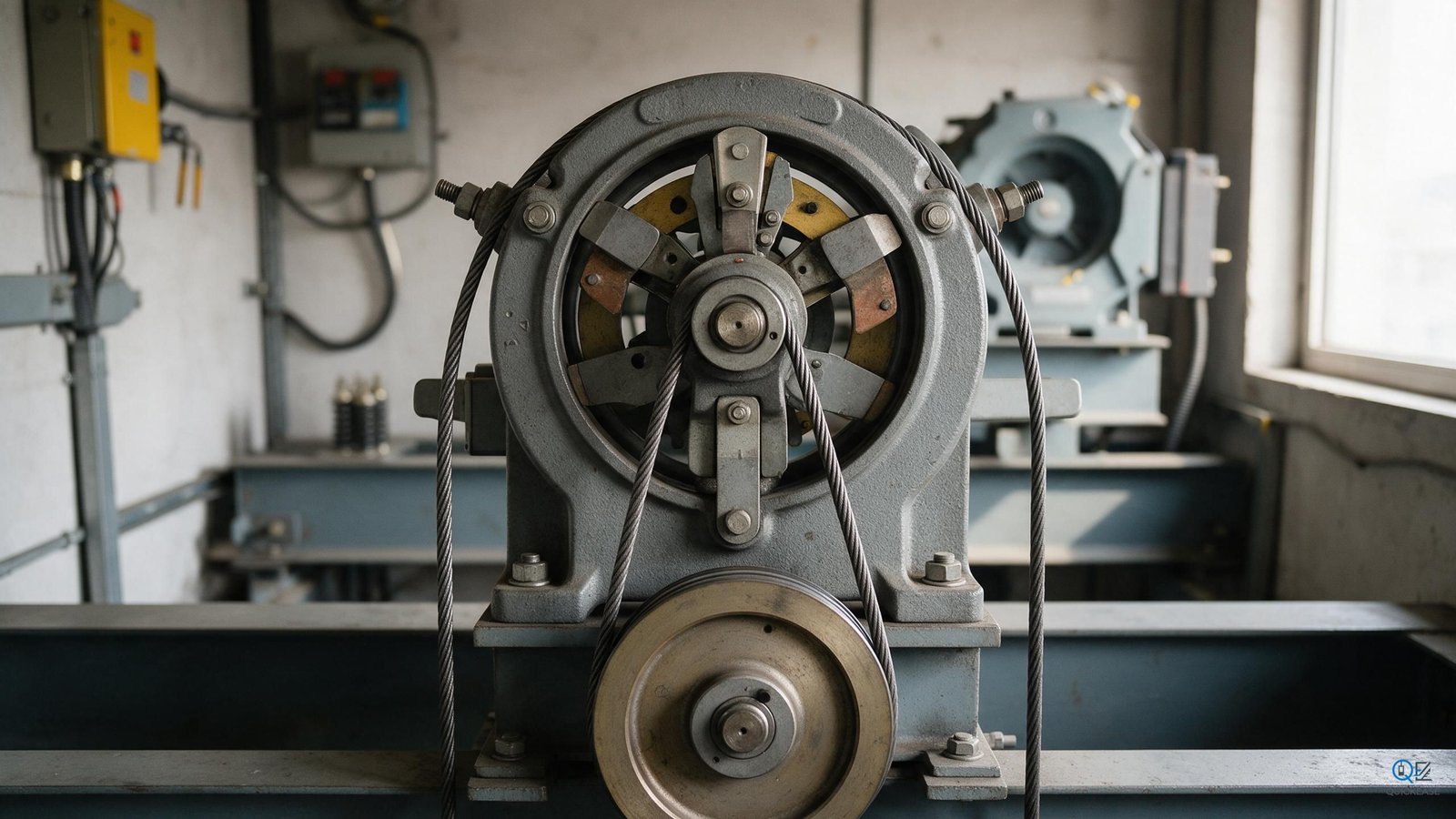
Every elevator has a device that assumes the worst: if the car runs away, it grabs the guide rails and stops it. Testing it is uncomfortable, because you are deliberately letting a machine do the thing it was built to prevent, and the only way to know it works is to make it work.
The system has three parts. The governor is a centrifugal device driven by its own rope, which runs in a loop from the machine room down to a tension pulley in the pit and back. Above a set speed, the governor's flyweights swing out and trip a mechanism that grips its rope. The gripped rope pulls a lever on the car, and the lever lifts the safety gear, which wedges against the guide rails and stops the car. Along the way a switch opens the safety circuit, cutting power to the machine.
The switch is supposed to operate before or at the same moment as the mechanical trip. If it operates late, the machine keeps pulling while the safety gear grips, and the ropes go slack. If it operates early, the car stops electrically and the mechanical test proves nothing. Check the adjustment, then test the mechanics by pulling the governor rope by hand, which trips the gear without overspeeding the machine.
Test with an empty car. Load the car with rated load only if the procedure or the inspector calls for it, and never with passengers. Run the car down at rated speed, trip the governor at the pit or with the test lever, and watch. The car should stop in the distance the manufacturer specifies, without a violent jolt, and it should stop reasonably level. A car that drops half a meter before gripping has a linkage that is too loose or a governor rope that is slipping.
Now get under the car and look at the rails. Each safety gear wedge leaves a bright mark where it gripped. Compare the two marks: they should start at the same height and be about the same length. Marks that start at different heights mean the gear is not synchronized, and the car stopped by skewing rather than by gripping. That is a fail, even if the car stopped.
The most common cause of unequal marks is a synchronizing rod out of adjustment, followed by one wedge that is dry or binding. Check both wedges move freely by hand with the car parked, and check the springs. A wedge that is stiff will always grip late.
Guide rail condition decides whether the test is meaningful. The braking surfaces must be clean and dry: no paint, no grease, no rust, no oil from a leaking jack or a lubricator. Oil on the rail is the single most common reason a safety gear "does not hold", and the cure is cleaning the rail, not adjusting the gear. If the shaft has a rail lubricator, it has to be positioned so it does not oil the braking zone.
The governor itself needs checking before the test, not after. Feel the rope tension at the tension pulley: too loose and the governor can slip instead of tripping, too tight and it loads the bearings. Look at the governor sheave groove for wear and at the rope for broken wires or a flattened section where it sits in the groove. The tripping speed can be checked with a tachometer on a test stand or by calculation from the machine speed; a governor that trips at 105 percent of rated speed will produce nuisance stops in a fast car, and one that trips at 150 percent is not protecting anything.
After the test, releasing the safety gear is its own job. Raise the car slightly to unload the wedges, release the mechanism per the manufacturer, and then check the car moves freely on the guides. A gear that does not release cleanly is a gear that will strand the next passenger. Then inspect the rails for scoring: a deep groove means the wedge or the rail needs attention before the next test.
Test the switch separately before the mechanical test. Disconnect the machine, or put it in inspection, and operate the governor switch by hand. The controller should drop the safety circuit immediately and refuse to run. If it does not, you have found a fault that the overspeed test would have hidden behind a mechanical stop. Then check the switch lever clearance: too close and the car stops on every fast run, too far and the machine keeps pulling after the wedges bite.
The tension pulley in the pit is easy to forget and expensive to ignore. Its spring keeps the governor rope tight enough to drive the governor without slipping. Feel the rope by hand: it should deflect a little, not sag against the floor. A pulley that has seized, or a spring that has lost tension, lets the governor run slow, which raises the effective tripping speed. That is the failure that turns a protection device into decoration.
Record everything: date, car, test load, tripping speed, stopping distance, mark heights, who witnessed it. In a building with four cars and a maintenance contractor that changes every few years, those records are the only proof that the safety chain was ever tested.
When ordering parts, the governor model and its tripping speed, the governor rope diameter and length, and the safety gear model are the four numbers that matter. A safety gear that fits the car but has the wrong wedge angle will grip too hard or too softly, and neither shows up until the day you need it.