
Ordering a replacement elevator PCB: what to send
October 29, 2026
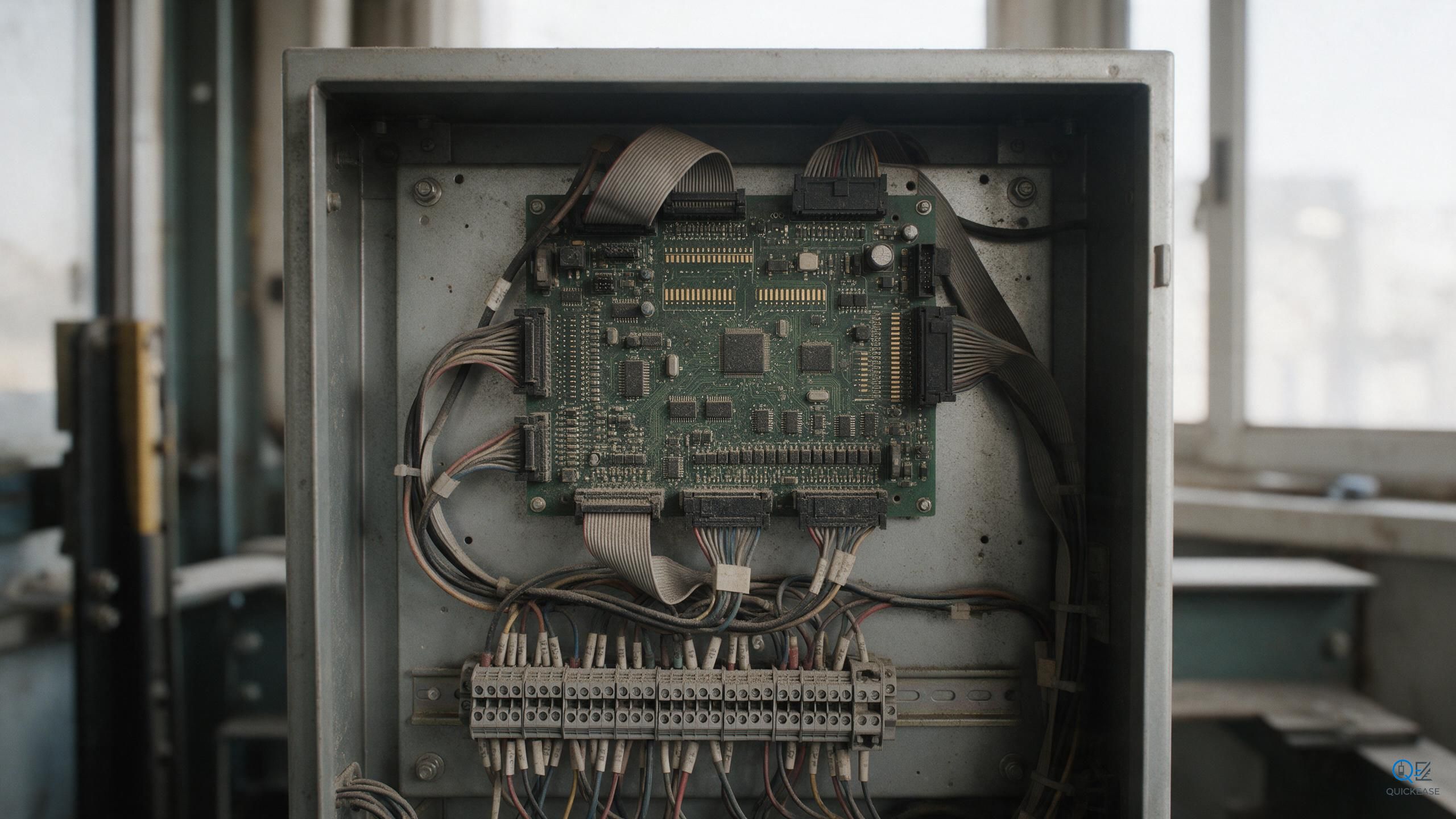
A control board fails in a machine room for a short list of reasons: a power supply capacitor that dried out, a relay that welded, an IGBT that died, water from a leaking shaft, lightning on the incoming supply, or a battery that leaked across the PCB and ate a track. The board is usually repairable. The problem is that the building cannot wait three weeks for a repair, so the maintenance company orders a replacement.
That is where it goes wrong. The part number on the old board may match the listing exactly, and the board may still not work, because the thing that makes a board specific to a machine is not printed on the silkscreen. It is in the EEPROM.
So collect evidence first. Six photographs, taken in daylight or with a diffused light, not with a flash pointed at a glossy board:
The whole board, component side, straight on.
The whole board, solder side, straight on.
Every sticker, including the serial number, the date code, and any hand-written label.
The microcontroller or EPROM with its printed label, if it has one.
The DIP switch block, with the switch positions legible.
The machine nameplate, or the controller nameplate, with model and serial number.
Then write down: the car number or group number this board belongs to, the error codes the controller displays, what the car does and does not do, and when it started. "Dead" and "runs but no levelling" are different faults and may be different boards.
Now the questions that matter, asked before the order.
Is the EEPROM programmed, and with which firmware version? A blank board with the right part number will power up and do nothing, or will run with default parameters that do not match the machine. Ask for the firmware version and compare it to the sticker on the old board. If the supplier cannot tell you the version, they do not know what they are shipping.
Are the parameters included, or do I have to clone them? Some systems keep parameters in a battery-backed RAM on the board; if the battery is dead, the parameters are gone and the new board will not know the floor heights, the rated load, or the contract speed. On those systems you need the parameter set from a service tool or a backup, and you should ask whether the supplier can supply it.
Is there a serialized chip that must be transferred? Some boards carry a small EEPROM or a security chip with a machine-specific key. On those, the old chip has to move to the new board, or the board has to be programmed with the machine ID. If the old board is dead, the chip may still be readable, and a repair shop can often recover it.
Then the less obvious things. Connector types change between revisions even when the part number does not. If the new board has a different connector for the door operator or the encoder, you need the mating harness as well, and that is a separate order. Photographs of the connector ends, not just the board, will catch this before it becomes a week of waiting.
Before you order, decide whether repair is the better route. A board with a failed power supply, a blown relay driver, or a burnt track is usually repairable, often within a week, and the repair keeps the original firmware and the original EEPROM. On a machine where the board is obsolete and no replacement exists, repair is the only option and should be the first call, not the last. The catch is that repair quality varies: ask what the repair shop tests, and ask for the board back with the failed components identified.
Counterfeit and "compatible" boards are a real category in this trade, especially for popular models. A copy can have the same layout, the same connectors, and different input filtering, and it will work until the first lightning season. If the price is a third of the others, ask why. A supplier who cannot name the firmware version and the test procedure is selling you an unknown.
On arrival, do not fit it straight away. Photograph the old wiring in place, one connector at a time, and label each cable with tape before you disconnect it. Then check the supply voltages at the board terminals with the old board removed: if the 24 V rail is at 19 V, the new board will fail the same way the old one did, and you will have spent the money for nothing.
Fit with the power off, use an antistatic wrist strap, and check the DIP switches against your photograph before applying power. Then bring it up in stages: supply only, look for the heartbeat LED, then inputs, then outputs with the motor disconnected if the system allows it. A board that is going to fail often fails in the first ten minutes, and it is cheaper to find that out with the motor isolated.
Finally, keep the dead board. It is the reference for the next order, it may be repairable as a spare, and the EEPROM on it may be the only copy of the parameters left in the building. Label it with the date and the fault, put it in a bag, and put it on the shelf in the machine room, not in the back of a van.