
Wire rope discard: what to measure before replacing
October 29, 2026
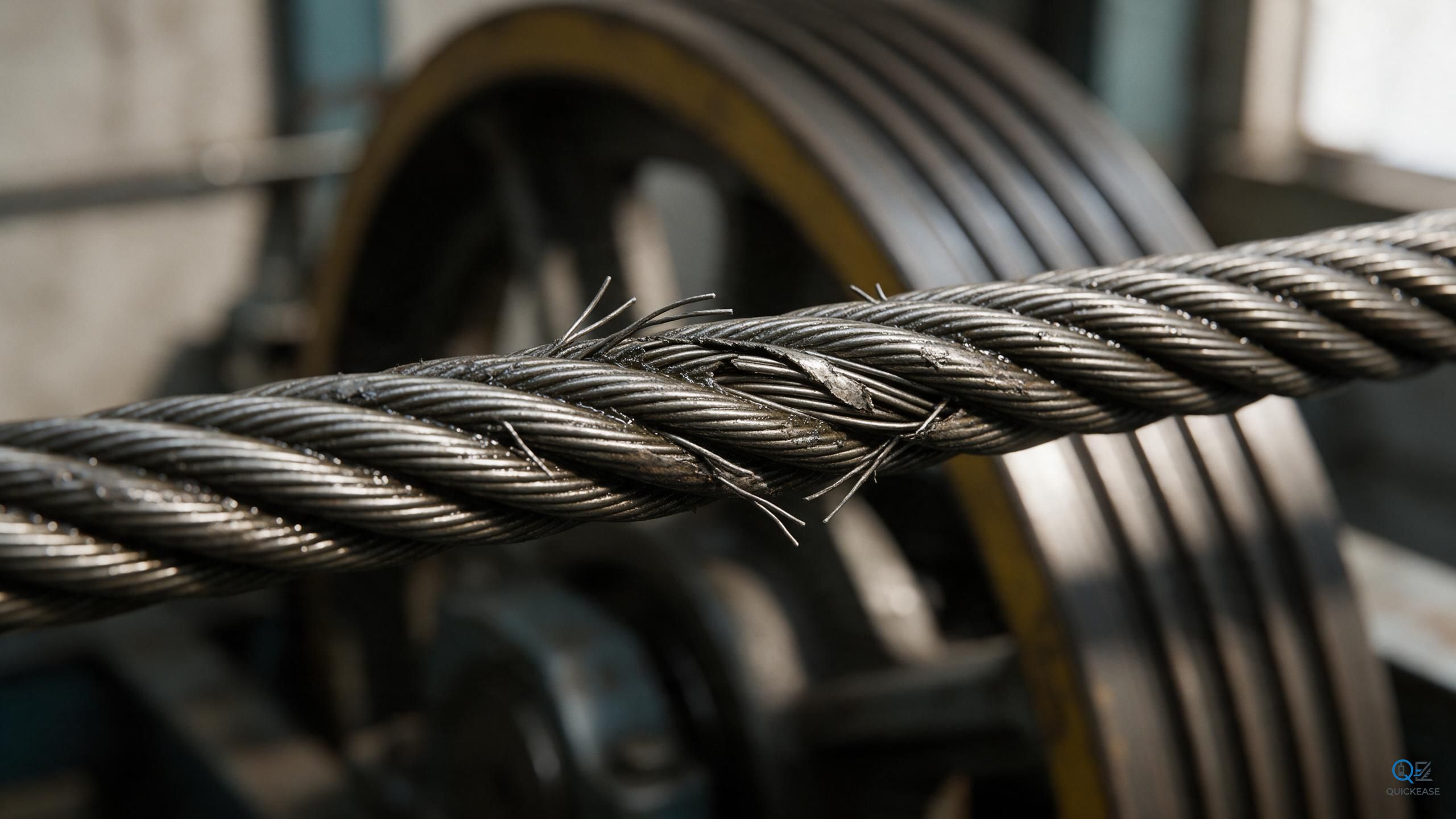
Ask five mechanics when to change traction ropes and you will get five answers, usually one number: broken wires. That number matters, but it is the easiest thing to see and not the thing that fails first in a real machine room.
A traction rope on an elevator is a fatigue machine. It bends over a sheave several thousand times a day at a diameter ratio that is only just acceptable, and it spends years in a hoistway that may be damp, dusty, or hot. The failure modes that come out of that are: broken wires, diameter reduction from wear and core compression, corrosion, mechanical damage, and loss of tension equalization. The standard tables cover all of them. People check one.
Start with the obvious, because it also tells you where to look. Wipe the rope with a rag over a length of about a meter, at three places: near the counterweight, at the car, and midway. Count the breaks you can see. Then do the same over the length that runs through the sheave, because that is where bending fatigue concentrates. If a rope has more than ten percent of its wires broken in any one lay length, it is finished. That rule of thumb is close enough for field work, and it is conservative for the common constructions.
Know what you are counting. A 6x19 rope has 114 wires plus the core; an 8x19 has 152. On a fibre-core rope the core contributes nothing to strength and hides internal breaks, which is why a rope can look clean outside and be rotten inside. If the machine runs in a wet or chemically aggressive environment, pull the rope slightly out of the groove at the sheave and look at the core. Brown staining and a soft, crushing feel mean the core is gone.
Diameter is next, and it is the check most often skipped. Measure across the crowns with a caliper, in two directions ninety degrees apart, at a straight section. Compare with the nominal diameter stamped on the certificate. Ten percent reduction is the usual discard point, and it usually means wear on the outer wires plus compression of the core. A rope that has lost six percent and shows no broken wires is still on its way out, and the sheave groove is usually the reason.
Lay length tells you about twist and stretch. Mark ten lay lengths on a clean section and measure. If the lay has lengthened noticeably compared with the certificate, the rope has been overloaded or has untwisted at a termination. Either one is a reason to replace, not adjust.
Then look at the ends, which is where most surprises live. A babbitt socket with a crack at the neck, a wedge socket with the wedge seated wrong, a ferrule with corrosion bleeding out of the crimp, or a rope that has pulled two millimeters out of its socket and left a bright ring. A mirror and a flashlight will show you the underside of a socket that you cannot reach with your hand. Do this on every rope at every annual inspection, and do it before you count wires, because a socket failure is an immediate stop, not a note for next year.
Mechanical damage is obvious when you see it: a kink, a birdcage, a flat spot from a rope jumping a sheave, a burn from a welder. Any of these is grounds for replacement regardless of the wire count. A kinked rope cannot be straightened back to service, and a birdcaged rope has already lost its lay.
Tension equalization deserves its own visit. On a four-rope machine, the load is only shared properly if the ropes are equally tensioned. One slack rope means the other three carry more, wear faster, and the sheave groove wears unevenly, which is how you get to the previous article. Measure tension with a gauge if you have one, or check the ropes by deflection: press each rope at the same point with the same force and compare how far it moves. Adjust at the equalizer or the termination, then re-check after a week, because ropes settle.
The standards set the strength margin, not the inspection interval. A traction rope is expected to have a safety factor of at least twelve with three or more ropes, sixteen with two, and the sheave diameter to rope diameter ratio is usually forty or more. When you replace, match the construction, the lay, and the core type, and replace the whole set. One new rope in a set of four will carry more than its share, and the old three will carry less, and the result is a set that fails earlier than if you had left it alone. Retension and re-level the car after the first week, then again after a month. New ropes stretch, and a car that levels badly after a rope change is usually just a car with four ropes at four different tensions.
Rope stretch is worth understanding because it is not the same as wear. New ropes settle for the first few weeks: the strands bed into each other, the core compresses, and the set gets longer by a few centimeters. That is why the car needs re-levelling after a rope change and again a month later. What is not normal is a rope that keeps stretching after six months. A rope that has grown by half a percent and cannot be re-levelled is a rope with a broken core, a slipping termination, or a load it was never sized for, and adjusting the equalizer will not fix it.
Last thing. Keep a rope log in the machine room: date, rope set number, diameters at three points, break counts, tension readings, and who did the inspection. When the next inspection comes around, the log tells you which rope is degrading and how fast, and that is the only way to make a replacement decision that is not a guess.