
Why retrofitted light curtains keep tripping the door
October 29, 2026
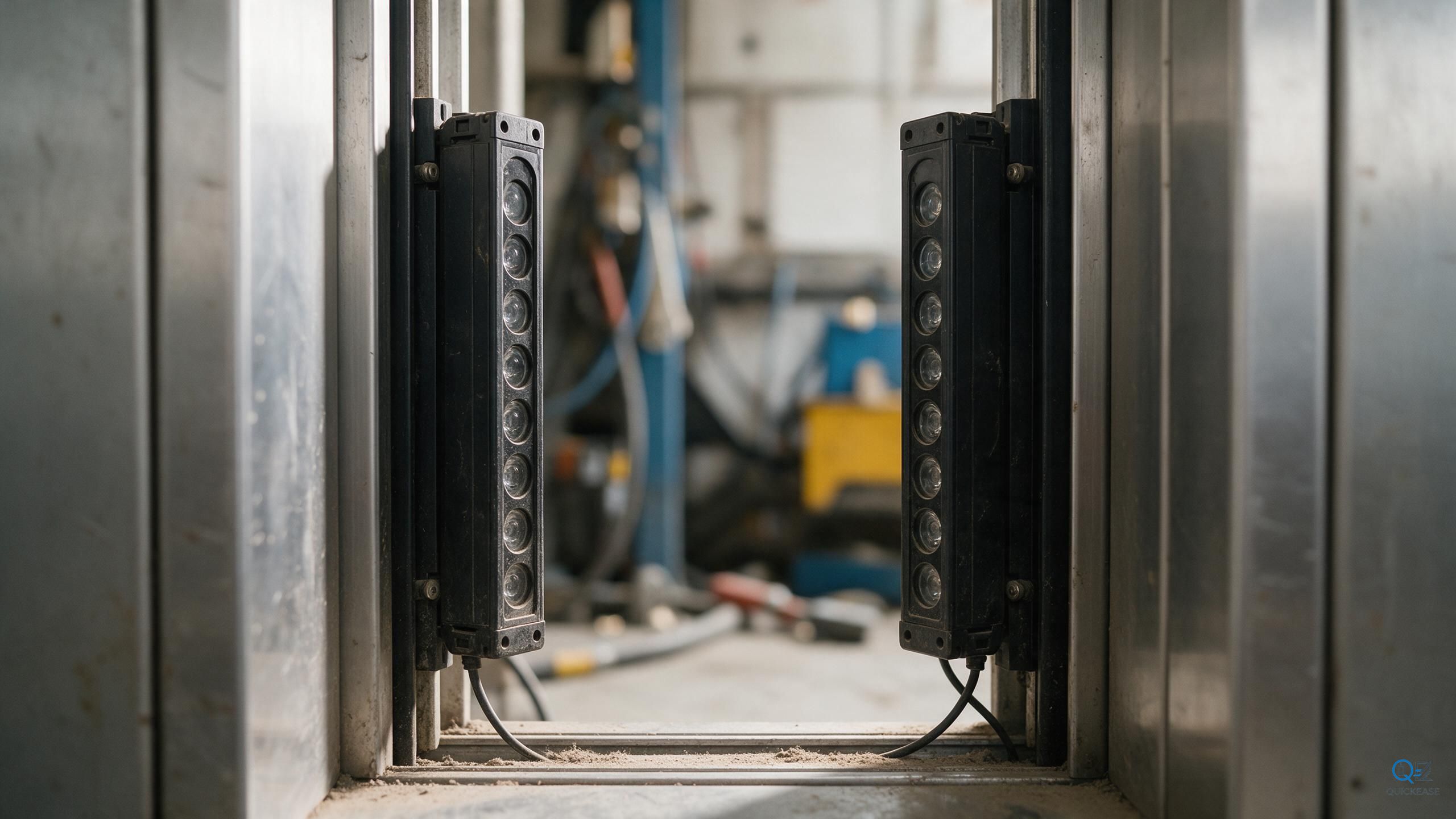
A hotel in the north of the city had three cars retrofitted with light curtains in the spring. By summer, two of them were reversing with nobody in the doorway, mostly in the afternoon, mostly at the lobby. The installer had been back twice and replaced the curtains once. When I got the call, the sensors were fine. The sun was coming through the lobby glass at four in the afternoon and reflecting off the polished stone floor into the receiver.
That is the first thing to understand about these devices: they are optical, and the door zone is a bad place for optics. Dust, sunlight, reflective floors, a chrome handrail, a passenger in a red coat. A photoelectric curtain that works on the bench will false-trip in a real lobby, and no amount of "re-calibration" fixes physics.
The second thing is that "light curtain" covers at least three different products. A two-dimensional curtain is a flat fan of infrared beams across the door opening. A three-dimensional curtain adds depth: it watches a volume in front of the door, not a plane, so a hand approaching from the side is detected before it reaches the plane. Then there are the older mechanical and ultrasonic edges, still out there on equipment from the 1990s.
For a retrofit, the two-dimensional unit is cheaper and easier to mount, and it is the one that generates most of the complaints. It has a blind spot at the floor, because the lowest beam sits 25 to 30 mm up, and a blind spot at the top if the mounting is set for a standard door height and the building has a 2.4 m opening. Trolley wheels, mop buckets, and children's shoes live in the floor blind spot. If your building has a lot of carts, pay for the three-dimensional unit.
Before blaming the sensor, measure the detection zone. Set the door to stay open, then run a 50 mm rod slowly through the opening at three heights: just above the sill, at 900 mm, and at 1600 mm. If any height fails to reverse the door, the curtain is mounted wrong or the beams are blocked. Then run the rod horizontally along the sill from one jamb to the other, because a curtain that only covers the middle 700 mm of a 1000 mm opening will miss a foot at the edge.
Now the electrical side, which is where the real nuisance trips come from.
Power. Most curtains want 24 V DC and draw very little, but they want it clean. Tapping the door operator's 24 V rail, which also feeds relays and a brake, is asking for dips every time the door starts. Run a separate 24 V supply from the controller if there is one, or at least check the rail with a scope during a door cycle. A dip below 20 V for 20 ms will blank the curtain and the controller will read "obstruction".
Output type. Sensors come with PNP, NPN, or relay outputs, and with normally open or normally closed logic. The door controller input expects one of these. A PNP sensor on an NPN input will either never trigger or always trigger, and the install manual will not mention it. Check the controller schematic before you buy, not after.
Cable. The cable from the car to the moving door panel flexes a few hundred times a day. Ordinary PVC cable work-hardens at the conductors and breaks inside the jacket, where you cannot see it. The symptom is a curtain that works until the door reaches a particular position, then loses the signal. Use a cable rated for continuous flexing in a cable chain, route it with a proper loop, and leave a drip loop at the panel entry.
Interference. The door motor is a VVVF drive switching at 8 to 16 kHz, and it sits centimeters from the curtain cable. Shielded cable, grounded at one end only, and a ferrite on the sensor lead solve most of it. If the curtain only trips while the motor is accelerating, this is your problem, not the sensor.
There is also the question of what the controller does with the signal. On some older controllers the input is a dry contact in the safety circuit, and the curtain's transistor output cannot drive it directly. You need an interface relay. Fitting a relay is ten minutes. Diagnosing "the door reverses randomly" without one can take three visits.
After the retrofit, test it the way an inspector will. Door open, 50 mm rod at three heights, three positions across the opening. Then test with the car moving: the curtain should be inactive in motion, or the door should not reverse while the car is running, depending on the controller logic. Then leave it for a week and read the fault log, if the controller keeps one. Nuisance trips that appear only in the afternoon are sunlight. Only in the morning are probably the low sun on the other side. Only when the car is at one landing are usually a reflective surface at that landing.
One last note on mounting height, because it is the most common installation error I see. The detection zone should start at the sill, not 50 mm above it. The sensor body can sit higher, but the beam geometry has to cover the bottom. Read the mounting diagram with the actual door width and height in hand, and if the diagram assumes a 2.0 m opening and yours is 2.3 m, the top of the zone will be short and the inspector's rod at 1600 mm will pass through nothing.
None of this is exotic. It is plumbing and optics. But it is plumbing and optics in a place that gets kicked, dusted, sunlit, and washed with a mop every morning, and the retrofit has to survive that for ten years.