
Identifying an elevator door operator without a nameplate
October 29, 2026
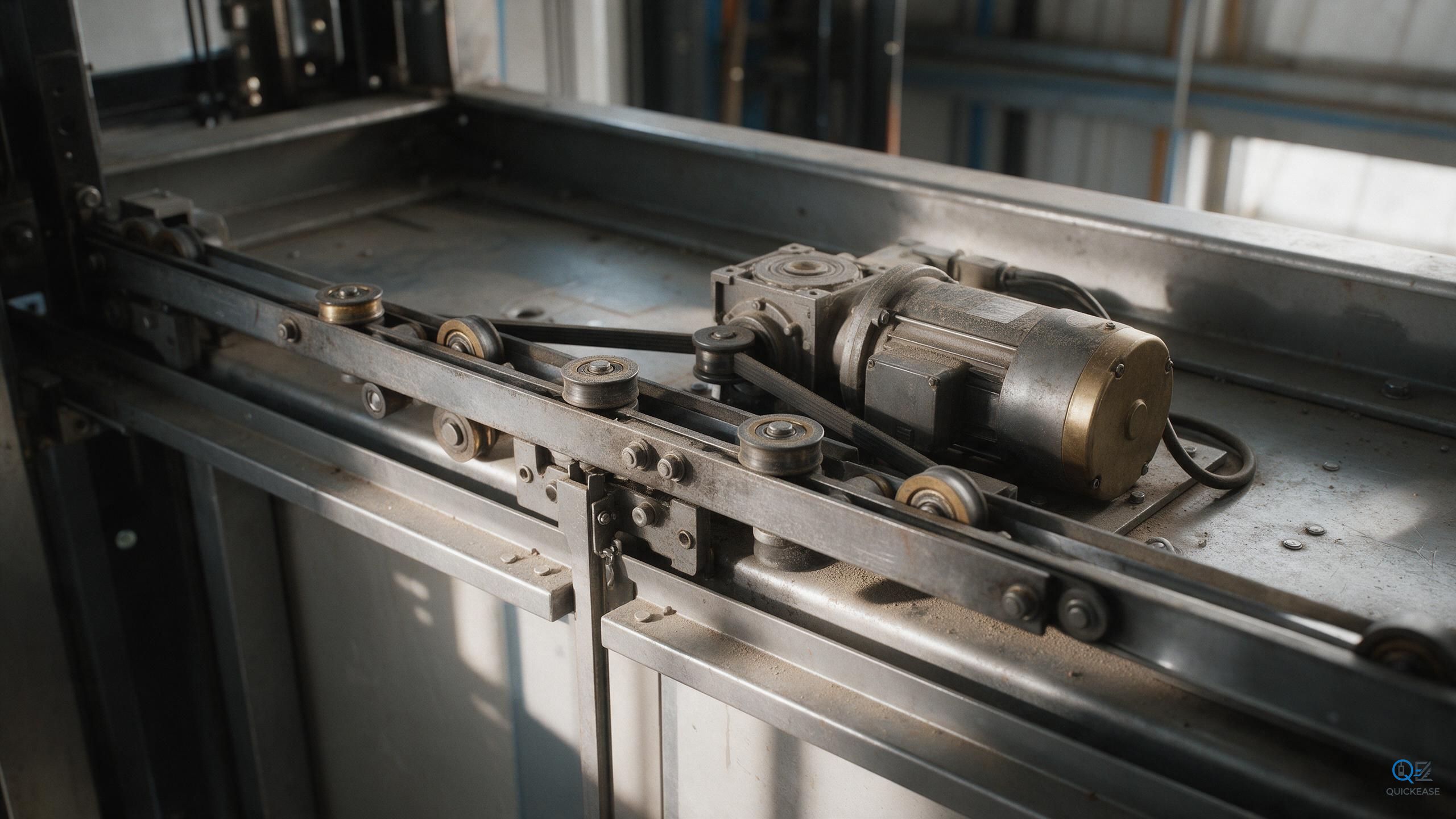
The call starts the same way most weeks. A twenty-five year old building, one car that keeps reversing, and a maintenance man holding up a phone with a photo of an operator that has no label on it. The sticker came off in 2011. The casting numbers mean nothing to anyone in the office. Somebody has already promised the customer a new operator by Friday.
Before anyone orders anything, take four photos. Not a video, not one wide shot from the corridor. Four.
The whole operator from the car top, standing back far enough that the hanger track, the motor, and both door panels are in the frame.
The hanger track and rollers from the side, close enough to read the roller diameter against a steel rule.
The motor and gearbox, including any cast or stamped numbers, and the belt if there is one. Lay a tape across the belt so the width is legible.
The controller board flat on, connectors visible, with light that does not glare off the coating.
Then measure. Four numbers do most of the work: clear opening width, panel height, roller spacing center to center, and belt width or output shaft diameter on gear-driven units.
Why those four. Clear opening plus panel height tells you the door type, and door type is where most wrong orders come from. A two-panel center-opening door and a two-panel side-opening door can share the same operator casting and still need different hanger arms, different belt lengths, and a different direction of travel. I have seen a "direct replacement" arrive with the correct bolt pattern and the wrong belt path. It sat in a crate for six weeks.
Roller spacing is the quiet one. Operators get rebuilt with non-original hangers all the time, and the spacing drifts by ten or fifteen millimeters. The new operator will bolt up and then bind, because the track geometry no longer matches the hanger.
Now the motor. Count the wires at the motor terminal block and look for the capacitor. A single-phase AC motor with a run capacitor is the old pattern, common on 1980s and 1990s European and Japanese equipment. Three phases and no capacitor usually means a VVVF drive, and VVVF means there is a controller that expects a specific motor, not just a motor of the same size. On a permanent magnet motor you will also find an encoder, five or six small wires in a shielded jacket, sometimes with a separate temperature sensor pair. If you see an encoder, the new controller has to learn that encoder, and the encoder has to be the right type. An incremental encoder and a resolver are not interchangeable, no matter what the terminal strip looks like.
The controller is where the money hides. Photograph the board, then read every string of text on it, including the small print near the edge and the sticker with the date code. Model numbers on door controllers are often silkscreened on the solder side as well. Note the terminal count and the supply voltage printed next to the terminals. Twenty-four volts DC is the modern default, but plenty of older boards run on 48 V or take 230 V AC straight in, and putting 48 V into a 24 V board is a fifty-dollar mistake that takes three days to discover.
Castings are worth a second look. Foundry marks, a two-digit year, a mold number. On European operators the same casting is often shared across a family, so the casting number identifies the family and not the variant. That is useful when the label is gone: it tells you which catalog page to open, and the measurements then pick the variant.
Some families you will run into repeatedly: Fermator and Selcom from Spain and Italy, Wittur and Sematic from Germany and Italy, Meiller, and a long tail of Chinese copies of all of them, some good, some not. Otis, Schindler, KONE, and Mitsubishi normally keep their door equipment proprietary, and a genuine replacement will come through their parts channel. If someone offers you a "universal" operator for an Otis 3200, ask what happens to the hanger brackets and the interlock interface before you pay.
There is one more thing to check before you order, and it costs nothing. Watch the door cycle ten times and count. Watch where it hesitates. On most operators the hesitation is at the last hundred millimeters, which is the creep speed setting, not a mechanical fault. If the door also hesitates at the start, look at the brake release timing. If it hesitates in the middle, look at the track and the sill guide. Half the operators replaced every year are replaced for a fault that lives in the track.
What a supplier actually needs from you is short and boring: the four photos, the four measurements, motor voltage and phase, encoder type or "no encoder", controller part number, door type, panel weight if you know it, and the duty the door runs at. A hotel door doing two hundred cycles a day and a hospital door doing two thousand are not the same purchase, even when the casting matches. Say which one you have.
If you cannot identify the family, send the photos anyway. Most of us who sell these parts have seen the casting before, and a photograph of the hanger track from the side is often enough to end the argument. What wastes everyone's week is a photograph taken from two meters away in a dark machine room, with the flash on, showing a gray box.